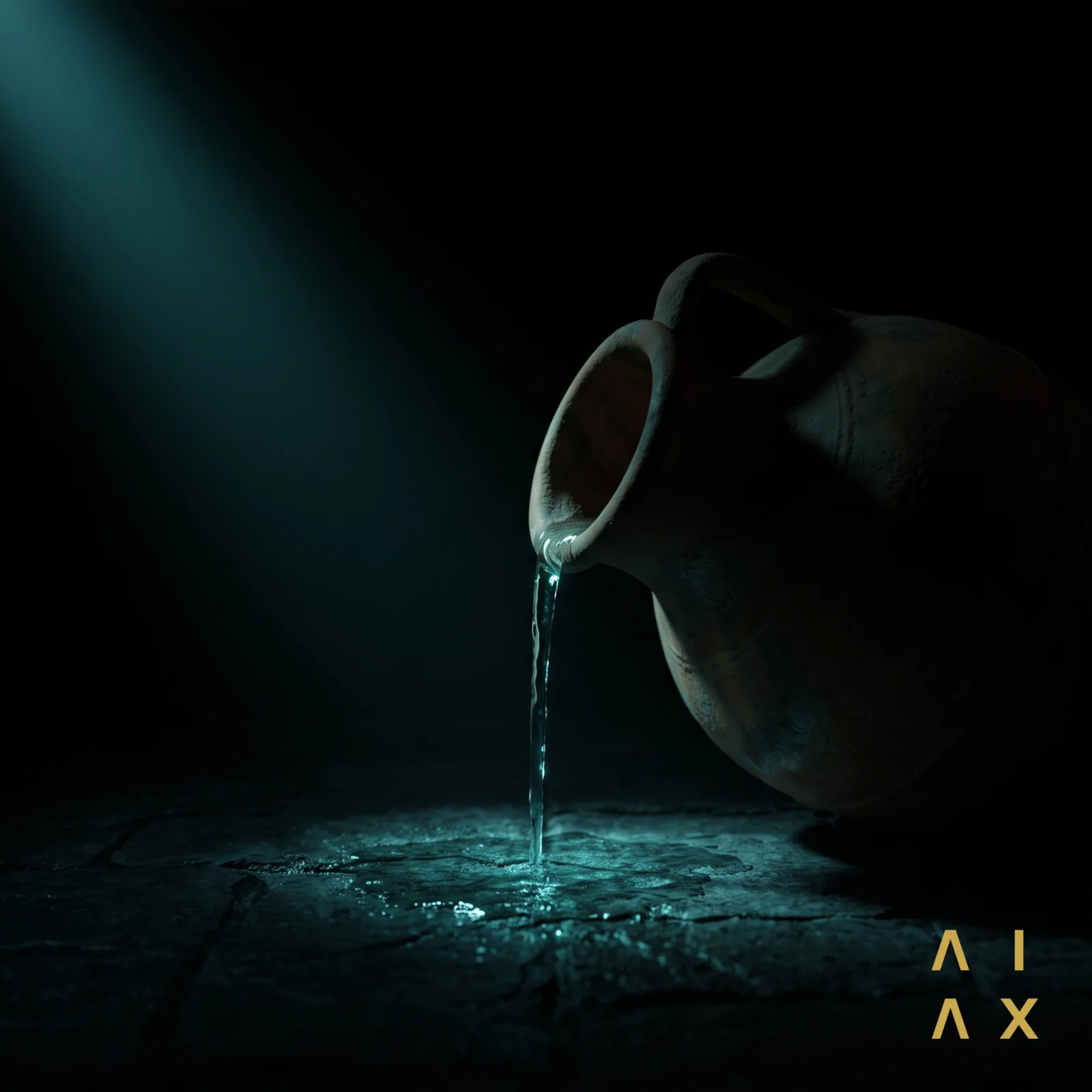
02 / 10 · AQUA
IMBER
Persia · Lydian · 4:42
Lucretius wrote that the rain dies when the sky pours it into the lap of the earth, and that the crops rise from it. The water in your glass today has fallen as rain countless times over the past four billion years. — Lucretius, On the Nature of Things I *"postremo pereunt imbres, ubi eos pater aether / in gremium matris terrai praecipitavit; / at nitidae surgunt fruges"* "Last of all, the rains perish when father sky has poured them into the lap of mother earth; but the shining crops rise up."
Some rain you remember. A storm on a summer evening that sent everyone running for cover. A cold drizzle on the way to a funeral. The first drops on a hot pavement and the smell that rises from it, which has its own name: petrichor.
Every one of those drops is very old. The water on Earth has been circulating for around four billion years, rising from the sea as vapour, travelling as cloud, falling as rain, soaking into soil and running back to the sea. An average water molecule spends only about nine days in the air before it comes down again. The rain on your window tonight has fallen many times before, on forests, deserts, glaciers and the heads of people who lived thousands of years ago.
Lucretius, a Roman poet of the first century BC, wrote a whole long poem to show that nothing in nature is ever truly lost. Everything is made of tiny particles that come apart and join again in new forms. To make his point, he chose the rain. It perishes, he wrote, when father sky pours it into the lap of mother earth, and from that death the shining crops rise, the branches turn green and the trees grow heavy with fruit.
His poem nearly vanished. For more than a thousand years it survived in only a handful of copies, until an Italian book hunter found one in a German monastery in 1417. From there its ideas travelled into the minds of Renaissance scientists and, some would say, into the modern world.
Nothing that falls is wasted. It goes where it is needed next.
Rain is easy to resent. It cancels plans, soaks shoes and turns an afternoon grey. Yet almost everything we eat began with a day like that. The ground needs it in a way we mostly forget, living on pavements and under roofs.
Much of what feels like loss in a life works the same way. Something falls apart, drains away, disappears into the ground, and for a long time nothing seems to come of it. Then, a season later, something is growing there.
IMBER follows straight after the spring and closes the circle: the water that rose from the ground falls back onto it as rain, soaks in, and will rise again somewhere else. A gentle, steady fall, with the sound of the ground underneath.
— Lucretius, c. 99–55 BC
LYRICS
Instrumental — no lyrics.