10 / 10 · AQUA
SPECULUM
3:13
Seneca wrote that mirrors were invented so that people might come to know themselves. Psychologists now use a mirror to test exactly that, and a human child only passes at around the age of two. — Seneca *"Inventa sunt specula ut homo ipse se nosset."* "Mirrors were invented so that man might know himself." (Natural Questions I.17)
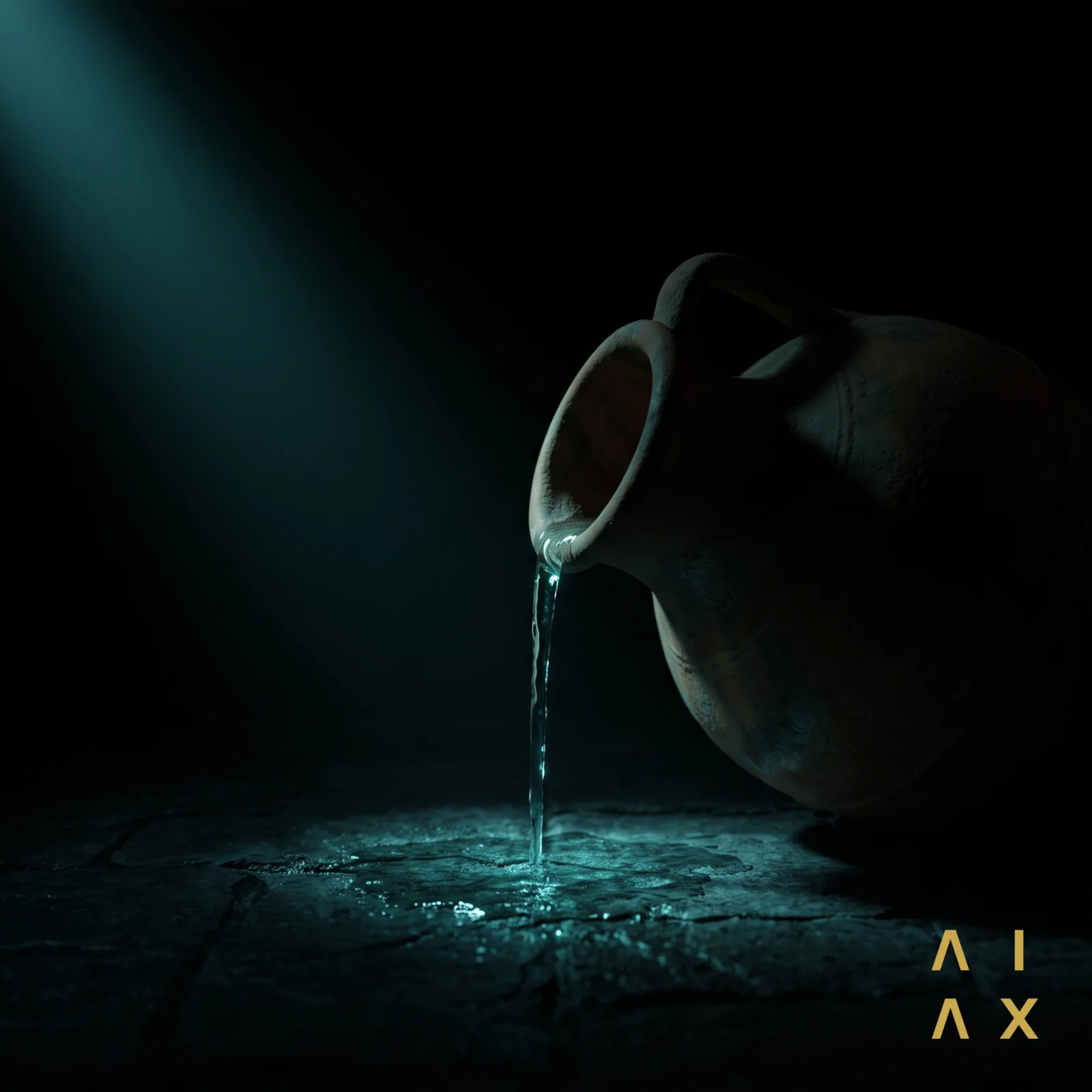
Before mirrors, there was water.
For most of human history, if you wanted to see your own face, you had to find a still pool, lean over it and wait for the surface to settle. The first mirrors were polished stone, then bronze, then silver. Clear glass mirrors like the one in your bathroom became common only a few centuries ago. Your great-great-grandparents may have seen their own faces fewer times in a lifetime than you do in a week.
In 1970 the psychologist Gordon Gallup put a small mark on the faces of chimpanzees and placed them in front of a mirror. Some of them reached up and touched the mark on their own face. They had understood that the animal in the glass was themselves. Very few species pass this test: great apes, dolphins, elephants, a few birds. Human children usually manage it somewhere between eighteen months and two years. Before that, the face in the mirror belongs to somebody else.
Seneca, writing about light and reflection near the end of his life, gave mirrors a moral purpose. They were invented, he said, so that a person might know himself: the young to use their strength well, the old to set aside what no longer suits them. For him the mirror was less about vanity than about honesty.
The difficulty is that we seldom look that way. We check the hair, the shirt, the tiredness under the eyes, and turn away. The mirror shows us a surface, and we are experts at looking only at the surface.
The mirror always tells the truth. The hard part is looking long enough to hear it.
There is another kind of reflection, one that needs stillness, like the pool before there were mirrors. A quiet evening, a walk alone, the last minutes before sleep. When the surface of the day settles, something looks back. It is not always what we expected.
Water mirrors have one more lesson. They work only when nothing moves. Throw a stone and the face breaks into a hundred pieces. Wait, and it gathers itself again.
SPECULUM closes AQUA. After the spring, the rain, the waves, the tides and the depths, the water finally lies still, and for the first time on the album it shows you your own face. It sounds like that surface: bright, shimmering, and in its calmer moments clear enough to see through.
— Seneca, c. 4 BC – 65 AD
LYRICS
Instrumental — no lyrics.