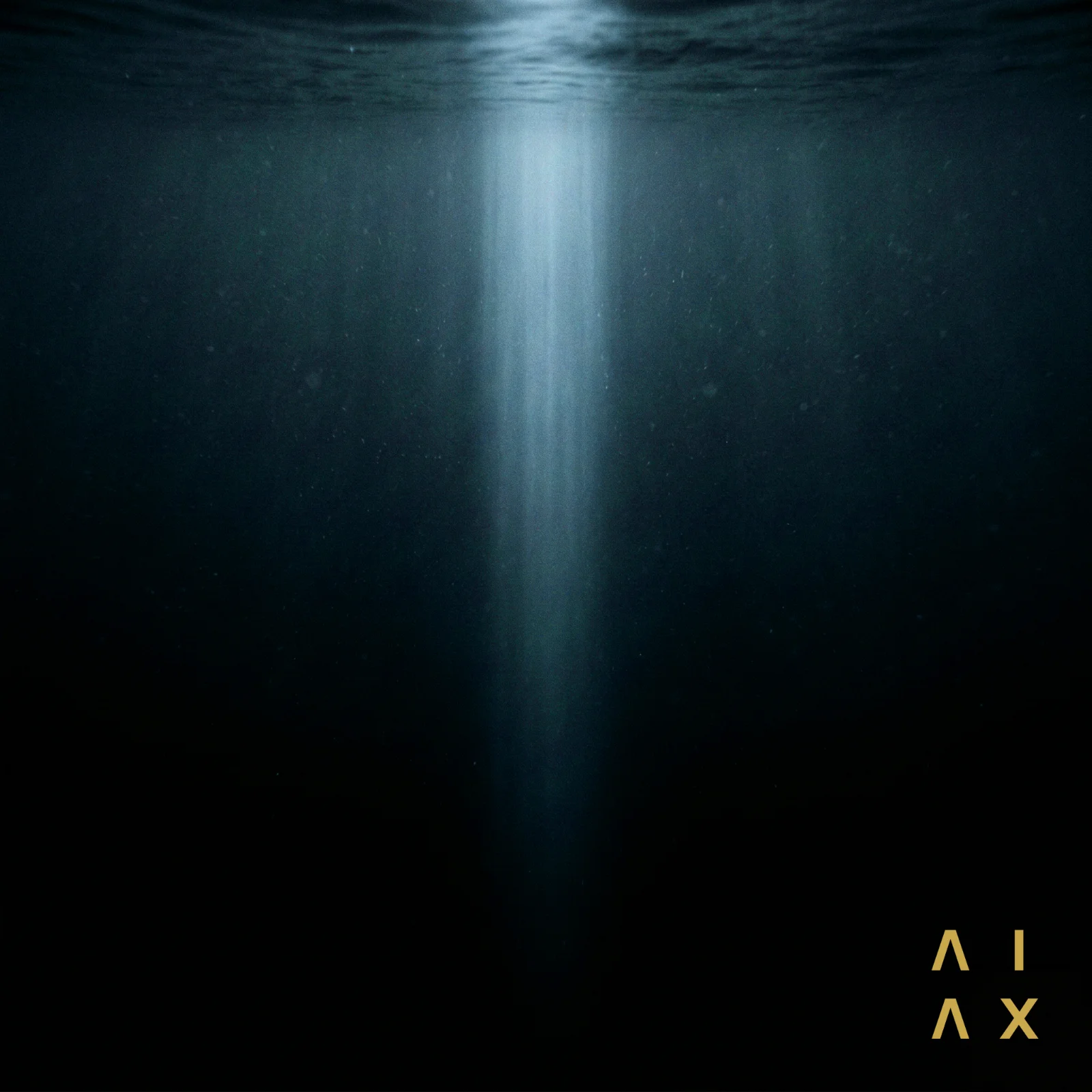
20 / 20 · INTROITUS · NOX
AKT III — NOX
OCEANUS
Egypt · Phrygian · 4:32
Before the gods, before the storm, before any god claimed to rule either — there was Oceanus. The first water. Hesiod named him. You are him.
“Ὠκεανόν τε, ὃς γαῖαν ἅπασαν ἐν κύκλῳ ἐστεφάνωσεν.”
“Oceanus, who crowns the whole earth in a ring.”
The final recognition — you are the sea.
Listen on Spotify ↗Also appears on
There is a moment most people reach at least once.
It comes on a bad week, or a long night, or a day that should have been ordinary. The work is too much. The relationships are strained. The body has not slept right. Some external thing — a market, an algorithm, a diagnosis, an empire — is doing something you cannot affect, and the helplessness of it gets into everything else. You sit at a table and notice you are very tired in a way that food and sleep will not fix. You feel like you are drowning. Not dramatically. Quietly. In a calm room with everything technically fine.
Modern language has gotten vague about this. We say stressed. We say anxious. We say burnt out. The ancients had a different vocabulary, and they named the feeling for what it actually is. You are in water that is bigger than you, and you cannot see the edge of it.
They called the water Oceanus.
In Hesiod's Theogony, written around 700 BC, the first living things are not the Olympian gods. They come later. Before Zeus, before Hera, before the twelve in their marble clothes, there are the Titans — the old primordial powers — and the oldest of them, the one Hesiod names first, is Oceanus. He is not the sea. He is the river that runs around the edge of the world. He is the water that holds everything else together. Every stream, every lake, every body of water in existence is his child. He is what is there before any god decided to be a god.
Ὠκεανόν τε, ὃς γαῖαν ἅπασαν ἐν κύκλῳ ἐστεφάνωσεν. Hesiod wrote it like this: Oceanus, who crowns the whole earth in a ring. A crown of water. The planet held in it. The word ocean in every modern language — English, Spanish, Czech, Arabic — still carries his name. Every time you say it, you are naming a Titan.
What almost no one remembers about Oceanus is that when the Titans went to war against the Olympians, he did not fight. He refused. He stayed at the edge of the world, holding his ring of water, and let the younger gods win. He was not defeated. He withdrew. And because he refused to fight, no myth has him killed. He is still there, in every version of the story. The oldest force in the Greek cosmos, quietly continuing.
You do not escape the ocean. You stop treating it as something outside you. The storm is not coming. The storm is what you are made of. The command is not to calm it. The command is to stand in it without drowning.
Seneca, seven centuries after Hesiod, wrote a book called De Tranquillitate Animi — On the Tranquility of the Mind — about exactly this problem. What do you do when the world is a storm and you cannot leave it? His answer is not to escape. It is to become the kind of person a storm cannot move. Not because you are stone. Because you are something older than the storm. You are water. You are made of the same substance. A wave does not frighten a wave. A sea does not fear the weather.
The song builds toward one line. I am Oceanus. A man half-drowning in the chaos of modern life — the responsibilities, the noise, the grinding uncertainty of being alive in the twenty-first century — hears something in himself clarify. Not a triumph. Not a conquest. Just a different word for what was happening. He stops trying to get out of the ocean and stands up in it. He realizes he has been the ocean the whole time.
This is where the Stoics, the Neoplatonists, and Hesiod agree with what any person who has survived a hard year already knows. You cannot make the water go away. You cannot outswim it. You cannot negotiate with it. What you can do — slowly, practically, without anyone applauding — is take back authorship of it. The ocean in your chest is not your enemy. It was the first thing in you and will be the last. The chaos of your days is not an obstacle to your life. It is a lot of what your life is made of. Owning it is not domination. It is recognition.
I am Oceanus. Not I am on the ocean. Not I have crossed the ocean. I am it.
That is the moment the record has been moving toward for twenty tracks. Not a doctrine. A quiet, unspectacular sentence, spoken in a dry voice on a night when you finally stop pretending the water is someone else's problem.
OCEANUS closes the album the way the old Titan closed the map of the world — by holding everything in a single ring and not moving.
— Hesiod, 8th–7th century BC; with Seneca, 4 BC – 65 AD
LYRICS
Drifting in the dark.
Caught between the calm—between the calm and... storm.
Echo to the dark form side the high of...
Horizon, horizon, horizon.
Horizon, horizon, horizon... fades to blue.

The shore.
Distant sight to flow, a flow, a flow.
Where echoes leave me through.

In the ocean, ocean, ocean, ocean
Ocean flow
Of the sky

Drifting in the dark.
Caught between the calm—the storm echo
to the dark form side the high of...
Horizon, horizon, horizon, horizon... fades to blue.

In the ocean, ocean, ocean, ocean, ocean,
Ocean, ocean,
Of the sky
Of the sky

Ocean... ocean... ocean... ocean...
ocean... ocean...

I am Oceanus.