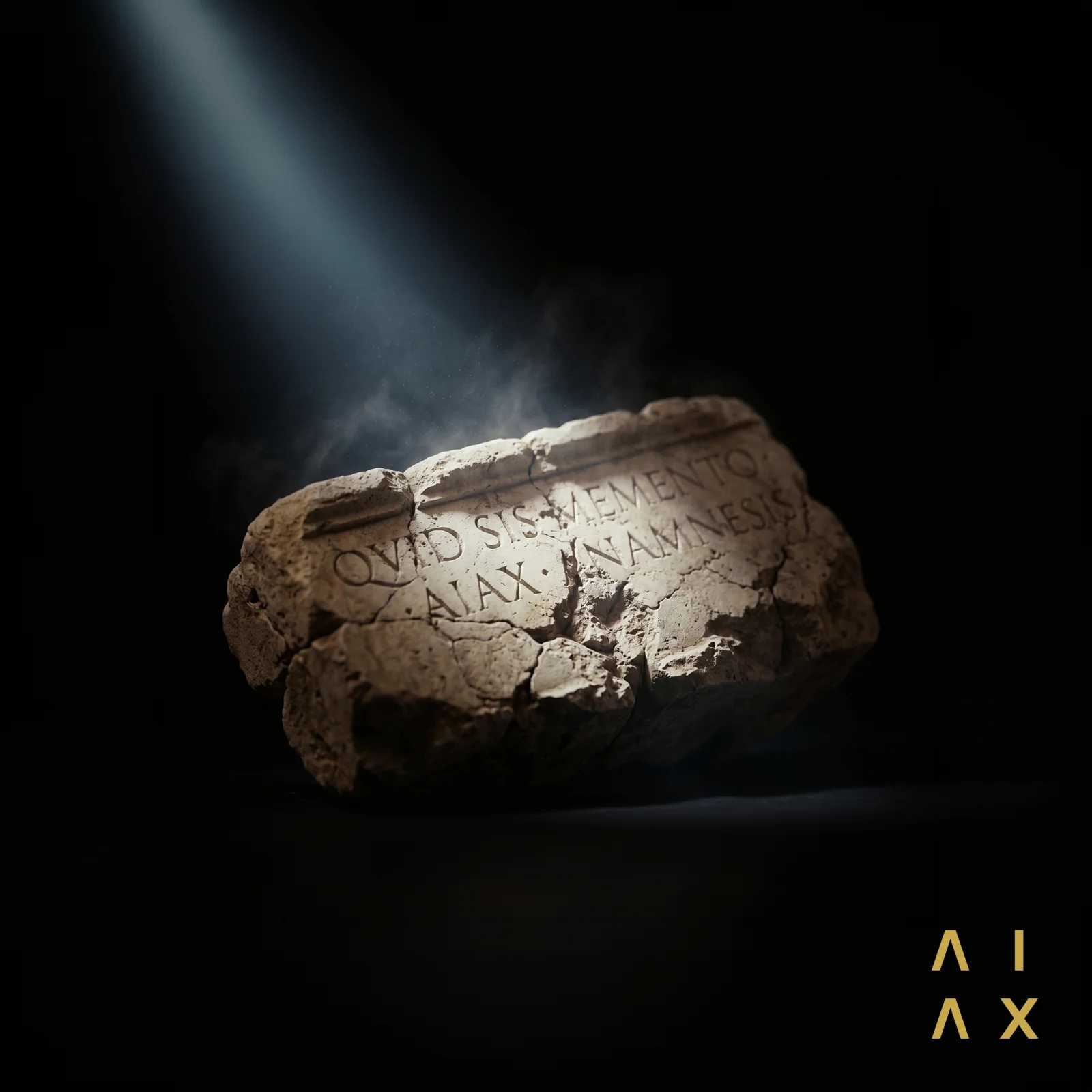
09 / 20 · INTROITUS · LUX
AKT I — AUREA
ANAMNESIS
Greece · Lydian · 3:56
Plato said the soul knew everything before it was born. Learning is not the arrival of new information. It is the return of something you once forgot.
“Τὸ γὰρ ζητεῖν καὶ τὸ μανθάνειν ἀνάμνησις ὅλον ἐστίν.”
“All seeking and all learning is nothing but remembering.”
The moment a forgotten thing returns.
Listen on Spotify ↗You have had this feeling before.
You read a sentence in a book and something in you straightens — not I did not know that, but I already knew that, I just did not have the words. You meet a person for the first time and the conversation is too easy, as if you had rehearsed it in another life. You hear a piece of music you have never heard, and the second time through you can sing the melody before it arrives. Most people dismiss these moments. A few notice that they happen too often to be coincidence.
Plato noticed. In the Meno, written in the fifth century BC, he tells the story of a slave boy who has never studied geometry. Socrates draws a square in the sand, asks a series of questions, and the boy proves a theorem he was never taught. Socrates then turns to Meno and says something strange: the boy did not learn this. He remembered it.
Plato called the idea anamnesis. The soul, he said, existed before this life and will exist after it. In between lives, it saw everything — every form, every truth, every shape the world can take. Then it was born into a body, and the shock of birth made it forget. What we call learning is not the arrival of new information. It is the slow recovery of something the soul already knew.
You do not learn. You only remember. Everything you will ever know is already inside you, waiting for a question that fits.
This sounds mystical. Plato was deadly serious. He built his entire theory of knowledge on it. In the Phaedo, written while Socrates awaited execution, he argued that recognition proves the soul is older than the body. You cannot recognize something unless you have seen it before. And you recognize truth — in mathematics, in music, in people — long before anyone explains it to you. Where did you see it?
The Celts had no word for anamnesis, but they had the bards. Every tribe had one — a person trained for twenty years to carry the memory of the whole people in their mind. Not just songs. Names. Laws. The shape of the land. When someone needed to know something, they asked the bard, and the bard did not look it up. They remembered. The druids went further. They believed the soul was not born with the body. It arrived already old, already carrying what the body would need to learn again. Two traditions, one insight: knowledge is older than you are.
Modern neuroscience does not confirm this, and does not need to. Because everyone, if they are honest, knows the experience. The thing you "always felt." The decision you "somehow knew was right." The word on the tip of the tongue that was never taught. These are not memories in the everyday sense. They are something quieter. Something that arrived when you did.
ANAMNESIS is the sound of a door opening onto a room you did not know you had.
— Plato, 427–347 BC
LYRICS
Anamnesis...

Anamnesis...

Anamnesis...

Anamnesis...