13 / 20 · INTROITUS · NOX
AKT II — VIBRATIO
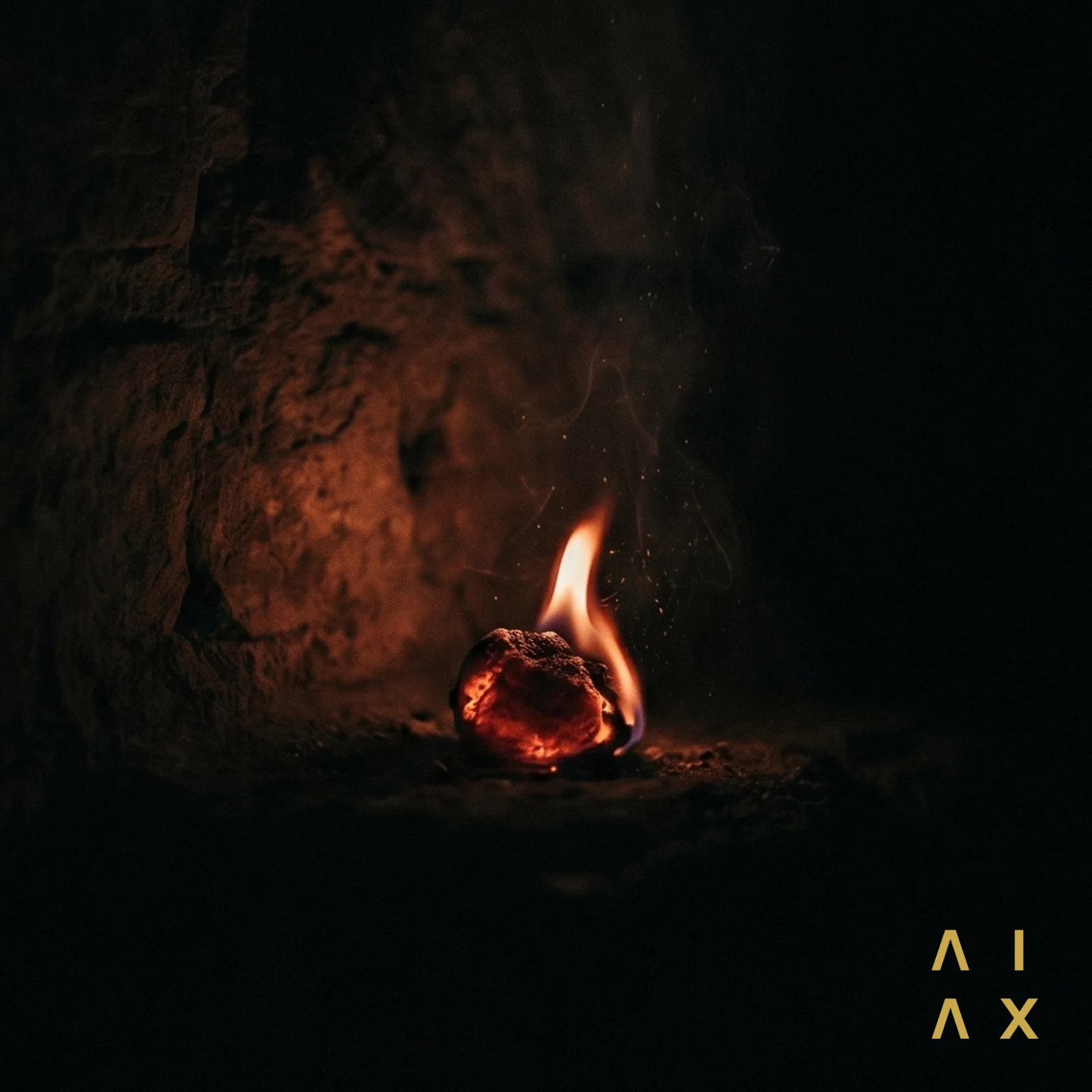
IGNIS
Rome · Dorian · 3:28
Heraclitus called the universe an ever-living fire. Twenty-five centuries later, astrophysics proved the calcium in your bones came out of exploding stars.
“κόσμον τόνδε, τὸν αὐτὸν ἁπάντων, οὔτε τις θεῶν οὔτε ἀνθρώπων ἐποίησεν, ἀλλ᾽ ἦν ἀεὶ καὶ ἔστιν καὶ ἔσται πῦρ ἀείζωον.”
“This cosmos, the same for all, no god or man made — but it always was, is, and will be: an ever-living fire.”
The eternal fire remembering itself.
Listen on Spotify ↗Also appears on
You are made of fire.
Not metaphorically. Literally. Every calcium atom in your bones, every iron atom in your blood, every carbon atom in your body — all of them were forged inside stars. Stars that lived for billions of years, ran out of fuel, collapsed, and exploded. The heavy elements they produced scattered across the galaxy, gathered into clouds, formed new stars, formed planets, formed rain, formed a single cell, and then — very slowly, over four billion years — formed you. The atoms composing you right now are older than the sun. They are, in the most precise possible sense, ancient light.
We learned this in the twentieth century. Stellar nucleosynthesis. It is settled physics. Carl Sagan put it into one of the most quoted sentences of the last hundred years: we are made of star-stuff. True. Verifiable. Humbling.
Heraclitus of Ephesus figured it out around 500 BC, without telescopes, without spectroscopy, without any instrument more sophisticated than his own attention.
He wrote this:
This cosmos, the same for all, no god or man made — but it always was, is, and will be: an ever-living fire, kindling in measures and extinguishing in measures.
Pyr aeizōon. Ever-living fire. He did not mean fire as in a campfire. He meant process — the universe as an eternal combustion, things becoming other things, energy cycling from one form to another, nothing created, nothing destroyed, only transformed. In another fragment he went further: all things are exchanged for fire, and fire for all things, like goods for gold and gold for goods. Twenty-four centuries before Einstein wrote E = mc², Heraclitus described the conservation of energy.
You are not observing the universe. You are a specific temperature of it — borrowed stardust, holding its shape for a few decades before returning to the fire.
How did he know? He did not. He saw. He watched a candle burn and understood that the flame was not a thing. The flame was an event. The same wax, differently arranged. He watched a river and concluded the same about water. Then about wood, stone, body, thought. Everything visible is stuff momentarily on fire. Solid objects are slow fires. Living bodies are faster ones. A thought is fire too — electrochemical combustion in a few pounds of warm neural tissue. Nothing in the universe rests. Everything is mid-burn.
The modern mind finds this uncomfortable because it dissolves the illusion of objects. We like objects. We like naming them, owning them, defending them. Heraclitus said the naming was a trick your mind plays on a process. You are not a thing. You are a specific pattern in the fire — a pattern that has held its shape since the moment you were born and will release its shape when you die, and the fire will continue.
Ignis aeternus. Flamma animae. Eternal fire. Flame of the soul. The Latin phrases in the song are not decoration. They are physics, translated into an older vocabulary.
When the music on this track says everything we are is ancient light, it is not speaking in poetry. It is stating what the best-confirmed science on Earth has told us since the 1950s, and what a grumpy Greek in a coastal city told anyone who would listen, long before anyone else figured it out.
IGNIS is the sound of remembering what you are made of.
— Heraclitus of Ephesus, c. 535–475 BC
LYRICS
Ignis aeternus...
Flamma animae.

A spark in the silence...
We are the dance of shadows.
Returning to the stars.

Luceat lux.
In tenebris.
Luceat lux.
Ab origine.

Stellae ignis.
Everything we are...
In aeternum.
...is ancient light.

LUCEAT!
STELLAE!
IGNIS!

Pure light.