14 / 20 · INTROITUS · NOX
AKT III — NOX
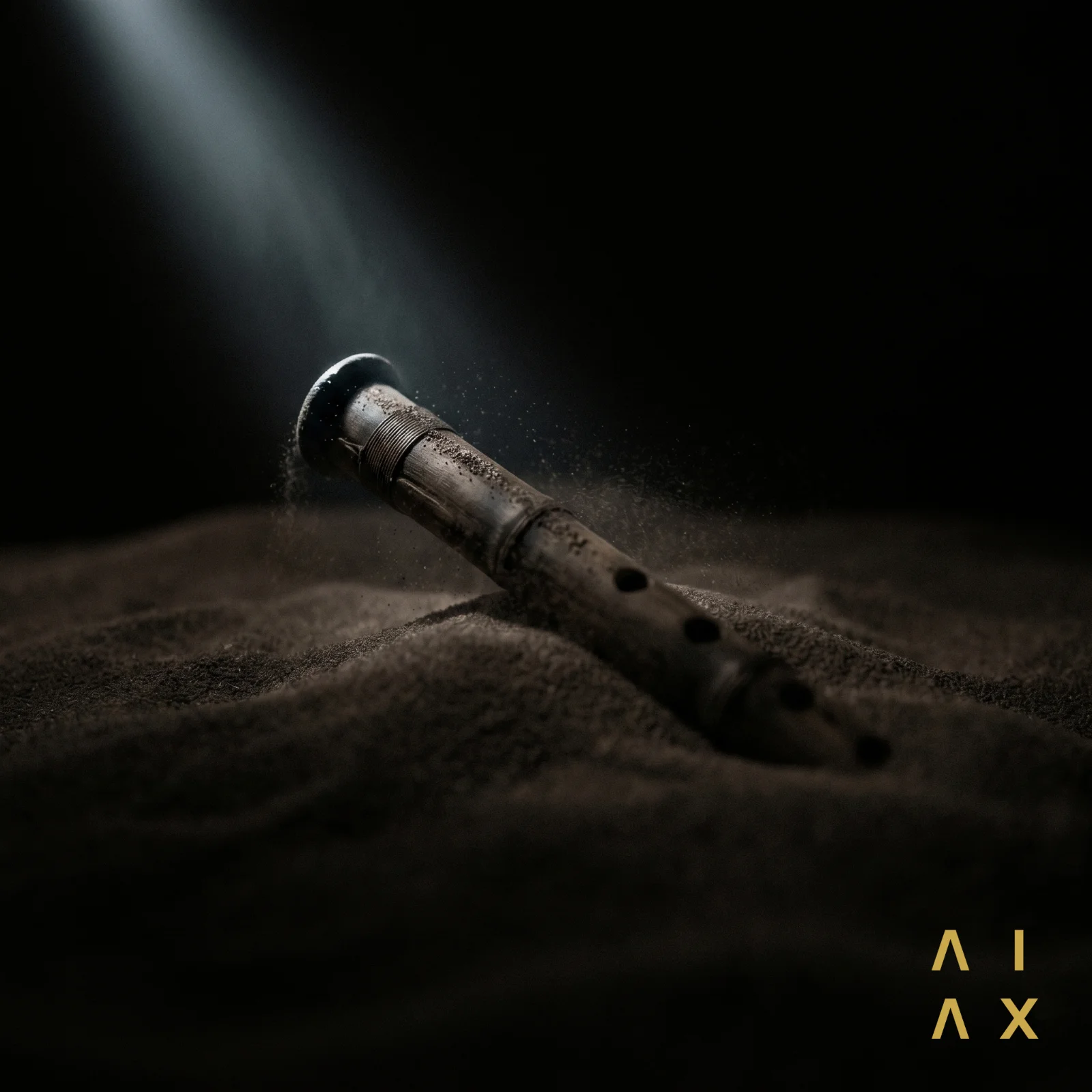
KHAMUSH
Persia · Lydian · 4:02
Rumi ended many of his poems by signing them with one word — Khamush. Silent. He meant it as both a name and an instruction.
“خاموش باش تا سخن بگوید خاموشی.”
“Be silent, so that silence itself can speak.”
The room after the question has been answered.
Listen on Spotify ↗Every poet signs their work. Most of them sign with their name.
Jalāl al-Dīn Rūmī, the thirteenth-century Persian mystic, sometimes did the same. But more often — in the thousands of ghazals he dictated during his life — he signed with one word: Khāmush. Silent. The Silent One. As if to say: I was the one who wrote this, and I am also the one who stopped writing. His pseudonym was not a name. It was a position.
Rumi was born in what is now Afghanistan, fled west as a child ahead of the Mongol invasion, and spent most of his life in Konya, in modern Turkey. He was a respected Islamic scholar and a quiet man until, at thirty-seven, he met a wandering dervish named Shams of Tabriz. Something happened in that meeting — no one knows exactly what — and the scholar turned into a poet. For the rest of his life he produced verse the way other people breathe. His Masnavi runs to twenty-five thousand lines. His collected ghazals, another forty thousand. And at the end of so many of them, one word. Khāmush.
He did not mean silence as absence. He meant silence as the limit of what can be said. In his culture, language was taken seriously — a ghazal could carry a spiritual teaching, a lament, a proof of God. But Rumi had noticed what every honest speaker eventually notices: the deepest things will not fit. You can circle them with words. You cannot catch them.
The deepest things are not whispered. They are not spoken at all. They arrive in the gap the words could not cross.
So he would write his poem — twelve lines, twenty lines, a hundred — and then, at the moment the poem had done all it could, he would stop and write Khāmush. Which meant: what comes next is not in the text. Look between the lines. Look in the quiet after the line ends. The poem was a door. The silence was the room.
Modern life does not allow much of this. Our phones are engineered so that silence feels like a malfunction. Open an app and something is already moving — text, video, notification, recommendation. We have trained ourselves to refuse the blank second. When it arrives, we fill it. And so the places where the deepest things could reach us are covered over before we can notice them.
Rumi would have recognized this. He wrote, in one of his clearest lines: Be silent, so that silence itself can speak. Not an instruction to shut up. An instruction to leave enough room that something besides you could finish the sentence. The Sufis called this practice sama — deep listening, sometimes with music, sometimes without — and the ritual the Mevlevi dervishes developed around it became the whirling dance you have probably seen in photos. They are not performing. They are making a very large quiet inside a moving body.
You do not have to whirl. You can sit. You can walk without the phone. You can be in a car for ten minutes without a podcast. Any of these, done regularly, produces what Rumi meant. The noise recedes, and something that was there all along gets a chance to be heard.
KHAMUSH is a track built around a single word because that is how Rumi built most of his poetry — everything pointing toward the silence at the end.
— Jalāl al-Dīn Rūmī, 1207–1273 AD
LYRICS
Khamush.

Khamush.

Khamush.